
Start eliminating debt for free with EveryDollar – https://ter.li/3w6nto Have a question for the show? Call 888-825-5225 …
source

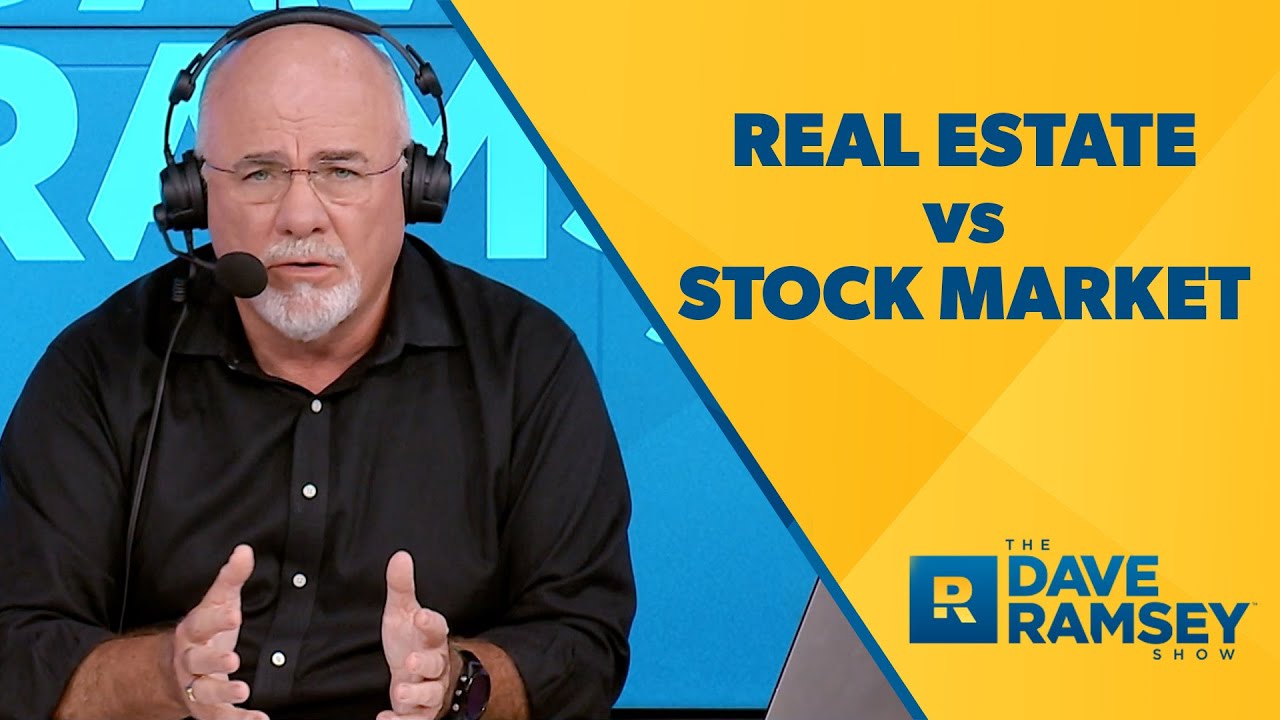
Start eliminating debt for free with EveryDollar – https://ter.li/3w6nto Have a question for the show? Call 888-825-5225 …
source
Input your search keywords and press Enter.







39 comments
Get life-changing financial advice anytime, anywhere. Subscribe today: https://www.youtube.com/c/TheDaveRamseyShow?sub_confirmation=1
In my opinion you need a balance of the two.
Stocks are fine until you retire. You're not contributing to it anymore since you have no more income. Real Estate is forever until the building collapses.
Exactly the kind of investing video beginners need: straightforward steps on how to start in the market, practical strategies you can actually use, and clear guidance that makes beginning feel achievable. I started investing when I was 37, mostly through sweat equity. I just turned 52, and this last month was the first time that my passive income broke $500,000
I think like this: Do both. Why?
1. You can take a mortgage and pay it off with a rent. So you leverage yourself on „safe” asset which is real estate. You should never do it on stock market.
2. Stock market is more volatile and you just see a number on the screen which doesn’t help you in everyday life. Real estate after paying off the debt can generate monthly income and help you survive cravings to finally use your money. If you don’t want to manage the property you can always use agency.
To conclude: put your money into stock while keeping a big enough to leverage yourself with mortgage. This way you can speed up financially on both sides. Would be perfect to do both inside and llc or family foundation to optimize the taxes even further.
My advice on stock is don’t pay for what the company is worth now. Pay for what it’s worth in the future. If you only look at the company’s current earnings, then you end up with companies that don’t have much growth in the future.
Real estate investment is very good, but if you pick the right stock, it could give you 400 times in return and no real estate can compete with that, but you can also lose everything if you pick the wrong one.
This guys sais total bs
3:27 IRR north of 15% would only happen on property that is highly leveraged, debt financed at low rate. But this same person always advocates not using debt to finance investment real estate
2:10 someone should let Ramsey know what Zillow or FRED or Lexis Nexis is.
1:51 the market has been returning 14% for the last ten years, 12% for the last twenty. This RoR is not matched by real estate.
My name is Jason and I'm in the same predicament haha
This discussion about real estate versus stocks really made me rethink how I was approaching investing. I used to think real estate was automatically safer and that stocks were mostly about buying something and waiting for it to rise. After making a few poor decisions, I realized I needed to understand the risks and reasoning behind each investment.
Real Estate can be more profitable and are more durable during an economic downturn, but it can also completely destroy your peace of mind. By far, the biggest mistake i've seen people make is that they assume real estate is passive income, it DEFINETELY is not. A single bad tenant can cost you thousands in legal fees and time, as well as destroy your property, there is a good reason most landlords become paranoid after awhile.
Stock market have higher return than real estate.
You can sell options, get dividends.
trade on options.
Etc
Real Estate will do the job…but it's a job! Stocks are easy…just put a bunch in or a little for a long time.
Often uninformed people toss around obtuse slogans like stock markets are a casino and real estate is a solid investment. Real Estate doesn't always go up in value – Great Financial collapse in 2007-2008 and the California Real Estate crises in the 1980s. Stocks don't always go up. However, over the long term, the US stock markets increase in value, and real estate values increase. There are good stocks that turn out poor. Great companies have poor stocks and vice versa. Properties fall in value for various reasons. Both investments require study. These investments are posed here incorrectly as somehow mutually exclusive as if it's one or the other. Real Estate, on paper, or in a book, sound great except when vacancies occur, renters don't pay, vandalism occurs, a toilet breaks, cutting the lawn, a storm hits or hiring a lawyer, spending time in court. Taxes, maintenance, utilities, and insurance all rise as well, which are overlooked. Stocks are hassle free. Mr. Ramsey is obviously biased for real estate which is understandable. His investment advice is sound but simplistic. There is nothing wrong with Real Estate and can be fruitful but fraught with aggravation that can be endless. Stock investment has none of the hassles but takes effort as well in terms of time, discipline, doing your homework. Yet if one has the inclination for repairs, fixing things as recreation, running back and forth to the hardware store, rolling up the sleeves, patronizing tenants with sweat and tears, go for it.
Real Estate : price of entry ticket higher than stock market, a lot more work, quite technical (you need a lot of knowledge), hidden costs
but it's much less volatile, at the end of the day you own something concrete which is likely to always have value, the rate of return can be higher.
Stocks : easy to buy, price of entry ticket very low, little work, quite technical also, smaller hidden costs
but if tomorrow the stock market crashes you'll have much less than the real estate guy
I don't live in USA but I chose real estate. Stock market scares me, I fear I could lose everything anyday, that's why I chose real estate.
Alot of nonsense from dave, a real estate propaganda machine
To Dave's point on information assimetry in the real estate market, it seems to me this assimetry isn't in favor of buyers, since sellers have a better knowledge of the asset
✨ Strong, highly practical framework shared by Ryan Serhant for be a successful real estate agent in 7 steps | ryan serhant. Prioritizing core high-leverage principles early in the process consistently yields compounding advantage over time.
I prefer stocks
Stock market is like a giant casino???? Really 😂😂😂😂😂 do people really know what casino is?
📈 Strong, highly practical framework shared by The Ramsey Show Highlights for real estate vs. stock market – which one will make me more money?. Prioritizing core high-leverage principles early in the process consistently yields compounding advantage over time.
No I think you are way off brother. Thats a 14,000K drop. Also you’re using historical data that does not work to this day. It’s just a different time. Your calculations would mean another 20 percent drop. A pullback yes but 50,000 I just think you’re way off. Clarity is on hold not off the table, your not gonna see that far if a drop in BCT
🚀 Terrific strategic breakdown by The Ramsey Show Highlights on real estate vs. stock market – which one will make me more money?. Maintaining organizational agility while staying anchored to fundamental domain principles is key as market dynamics shift.
Reaching retirement at 48 and seeing $28k biweekly is an absolute blessing. Yet, the real victory is knowing my family was there through every step of the hustle their unwavering support means the most. Thank you.
Real estate offers unmatched cash flow control and tangible appreciation, while equities provide effortless scalability and liquidity. 💡 Balancing both asset classes around your cash-flow needs is the true engine of generational wealth.
The caller seemed clueless
Real estate is only great if you can pay cash for it. Taking out a mortgage and relying on renters is not a great business plan.
Excellent analysis of the current US housing market. Thanks for sharing!
In California, there is rent control so income growth is stunt. Most value is in the land so not much depreciation. Rates are high now so you can't build up equity much because most of your payments go into interest not principal. Cap rates are up due to higher rates so appreciation is stuck. Leverage at higher rates is riskier. On top of that government is driving businesses and rich people away so less high paying jobs for your tenants. On top of that tenants have more rights than landlords and the cost of maintenance and repairs make RE investments much less profitable. The Old rules are not working in California.
This is one of the most frustrating calls Dave has ever taken. He takes his time to go in depth on the two topics in great detail. Only for the caller to say. “But it feels like…”
He would've quadruple his money had he invested in market 6 years ago.
Just buy a house every 10 years, by the time you retire youll have over 5k in cash flow. Plus your ssi plus whatever other money you saved.
He pretty much called the caller DUMB
I do both, invest in the stock market, and own single-family homes, and some small apartment buildings, totaling 30 or so units. Dave nails it. Real Estate SHOULD outperform stocks and kicks off cashflow.
It is nice to have "liquid" stocks I can sell instantly.
It's also nice to have some employment outside of the stock market, IE property management. I am the property manager of my own properties. Every worker, or manager you bring it will significantly impact your cashflow. It's up to you to decide the load you are willing to take on to manage, versus not at all.
Real estate is real headache in Texas, its draining with property taxes, low appreciation, and high insurance and maintenance costs.
The term is INEFFICIENT market, Dave.
And it's PRICE-to-Earnings Ratio. Honestly, do you even do this for a living? 🤡
I love someone who said on the internet once: 'My Vanguard roof never leaks'